
Fusion Basics
An introduction for Fusion Enthusiasts
Why Fusion?
Fusion has the potential to provide a sustainable, low-carbon and virtually inexhaustible source of energy for future generations. The fuel is abundant: deuterium can be extracted from seawater, while tritium can be produced from lithium. Unlike fossil fuels, fusion produces no greenhouse gas emissions during operation and, unlike today's nuclear fission reactors, it cannot sustain an uncontrolled chain reaction.
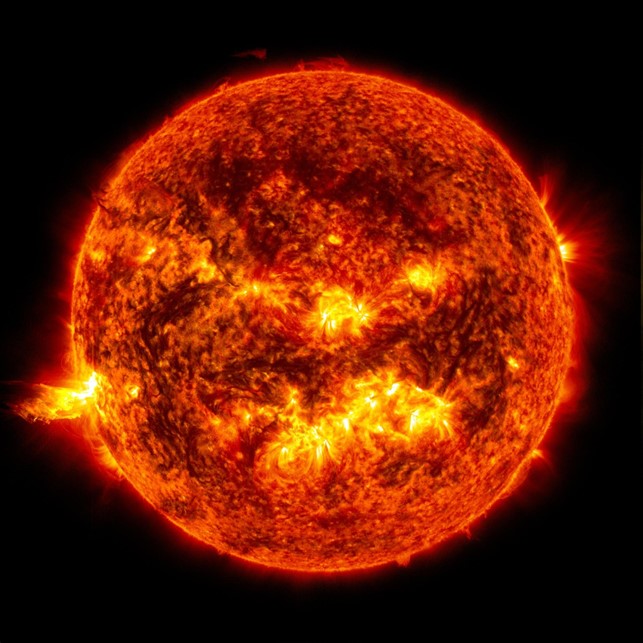
Fusion is the same physical process that powers the Sun and the stars. The challenge for scientists and engineers is to recreate these reactions under controlled conditions on Earth and convert the released energy into electricity. Understanding the underlying physics is the first step toward understanding fusion power plants.
The Physics of Fusion: From Stellar Fusion to D–T Plasmas
Fusion releases energy when light atomic nuclei combine to form a heavier, more tightly bound nucleus. A small fraction of their mass is converted into energy according to Einstein's famous equation E = Δmc². To make fusion possible, positively charged nuclei must overcome their mutual electrostatic repulsion—known as the Coulomb barrier—by colliding at extremely high temperatures, very high densities, or both.
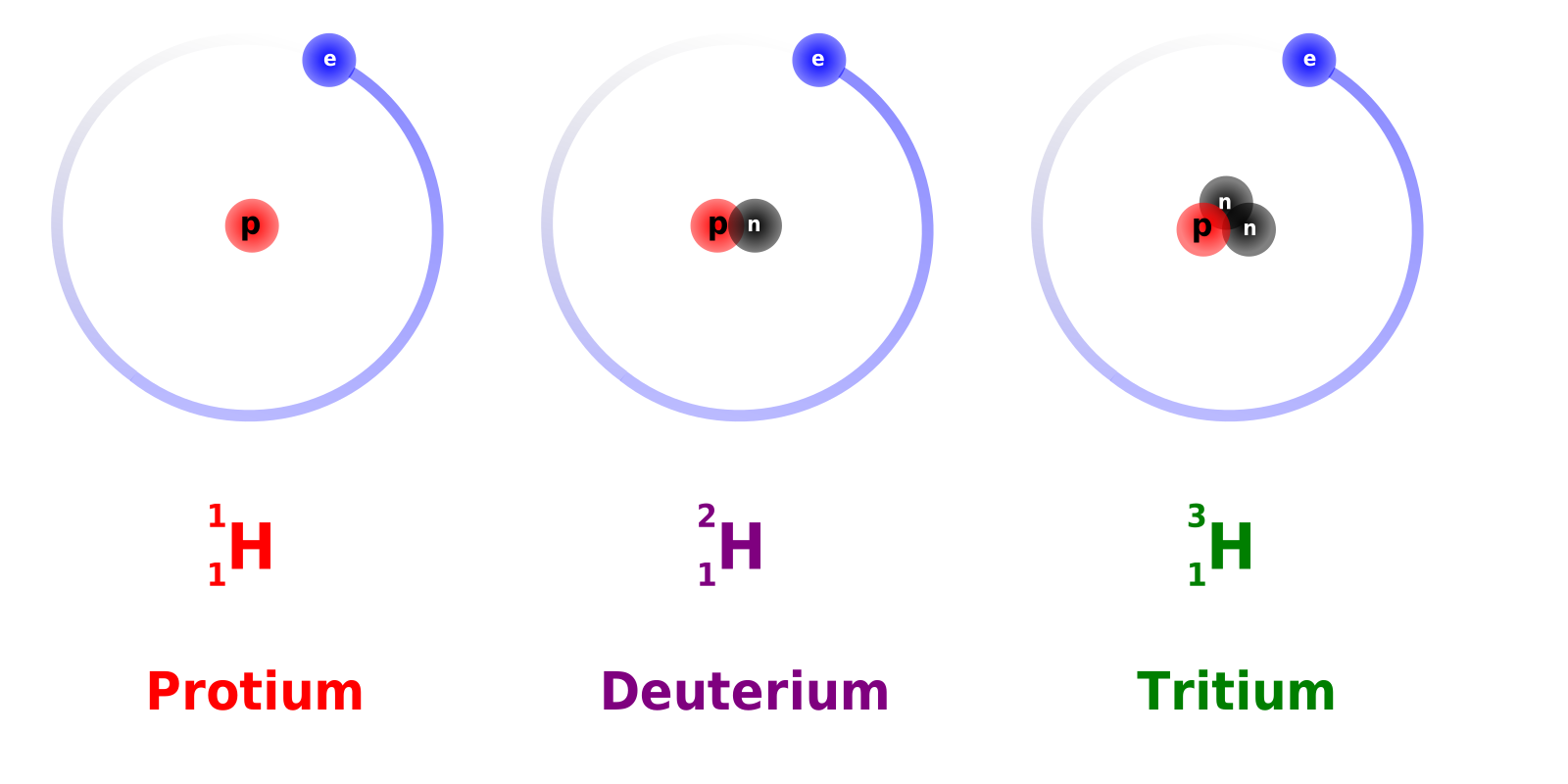
Hydrogen (protium), the lightest element, consists of a single proton. It also exists in heavier forms, called deuterium (D) and tritium (T), which are chemically identical to hydrogen but contain one and two additional neutrons, respectively. These "heavy hydrogen" isotopes fuse much more readily than ordinary hydrogen and therefore form the basis of virtually all fusion power plant concepts.
Fusion in the Sun: The Proton–Proton Chain
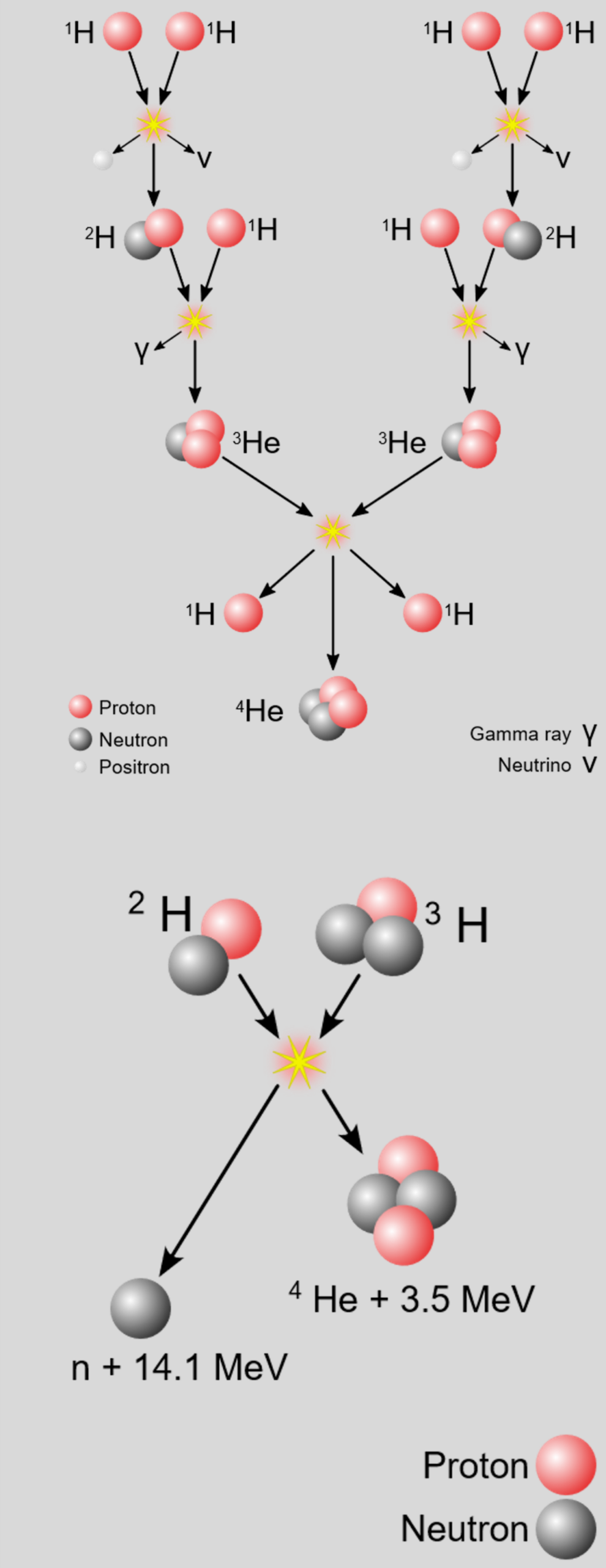
In the Sun, energy is generated through the proton–proton (pp) chain. The overall net reaction is:
4 ¹H → ⁴He + 2 e⁺ + 2 νₑ + 26.7 MeV
Four hydrogen nuclei ultimately combine to form one helium-4 nucleus, releasing energy in the process.
The first step:
p + p → D + e⁺ + νₑ
is governed by the weak interaction and therefore occurs very slowly. This slow reaction rate is why the Sun burns steadily for billions of years rather than exploding rapidly.
In the solar core, temperatures reach about 15 million kelvin and extremely high density allows Fusion to proceed despite the Coulomb barrier. Gravity provides the confinement needed to maintain these conditions.
Fusion on Earth: The Deuterium–Tritium Reaction
In a terrestrial Fusion reactor the proton–proton chain is far too slow to be practical. Instead, almost all current fusion concepts use the much more efficient deuterium–tritium (D-T) reaction:
D + T → ⁴He (3.5 MeV) + n (14.1 MeV).
The total energy released is 17.6 MeV.
Deuterium is abundant and can be extracted from seawater. Tritium, however, is radioactive and does not occur naturally in significant quantities. It must therefore be produced artificially—typically by breeding it from lithium inside magnetic confinement reactors, or supplied through an external fuel cycle for most inertial fusion concepts.
The D–T reaction has the highest fusion probability at temperatures of 100–200 million kelvin—much hotter than the core of the Sun. These higher temperatures compensate for the much lower particle densities achievable in laboratory plasmas.
The energy released in each D–T reaction is divided between a helium nucleus (an alpha particle) and a neutron. The charged alpha particle remains confined in magnetic fields and transfers its energy back to the plasma, providing self-heating. The neutron escapes and deposits its energy in a surrounding blanket, where it is converted into heat and then electricity.
For sustained Fusion the heating from alpha particles must exceed total energy losses:
Pα ≥ Ploss.
When this balance is achieved, the plasma enters the burning regime.
Stellar vs. Terrestrial Fusion
Both stars and Fusion reactors rely on overcoming the Coulomb barrier between positively charged nuclei. The difference lies in how this is achieved:
- The Sun uses extremely high density provided by gravity.
- Fusion reactors use much higher temperature to compensate for lower density.
The overall requirement for net energy production is summarized by the triple product:
n · T · τE,
which combines density, temperature, and energy confinement time.
How Do We Hold a Star on Earth?
Before heating a gas to fusion temperatures, a more fundamental question must be answered:
How can such extreme matter be kept in place?
Fusion requires temperatures above 100 million degrees Celsius. At these temperatures, matter becomes a plasma — an ionized gas in which electrons are separated from atomic nuclei. No solid material can withstand direct contact with such heat. A Fusion plasma cannot simply be placed inside a container: any wall it touches would cool it instantly and be severely damaged.
Fusion systems must therefore either confine the plasma without contact with material walls, or compress it so rapidly that Fusion occurs before the fuel can disperse.
Two principal strategies have emerged:
- Magnetic Confinement Fusion (MCF)
- Inertial Confinement Fusion (ICF)
Both approaches aim to achieve the same goal: sufficient temperature, density, and confinement time for net energy production.
Magnetic Confinement Fusion (MCF)
Because a plasma consists of charged particles, it can be controlled using magnetic fields. Charged particles spiral along magnetic field lines and are largely prevented from crossing them. If these field lines are arranged in closed paths, the plasma can be confined away from material surfaces.
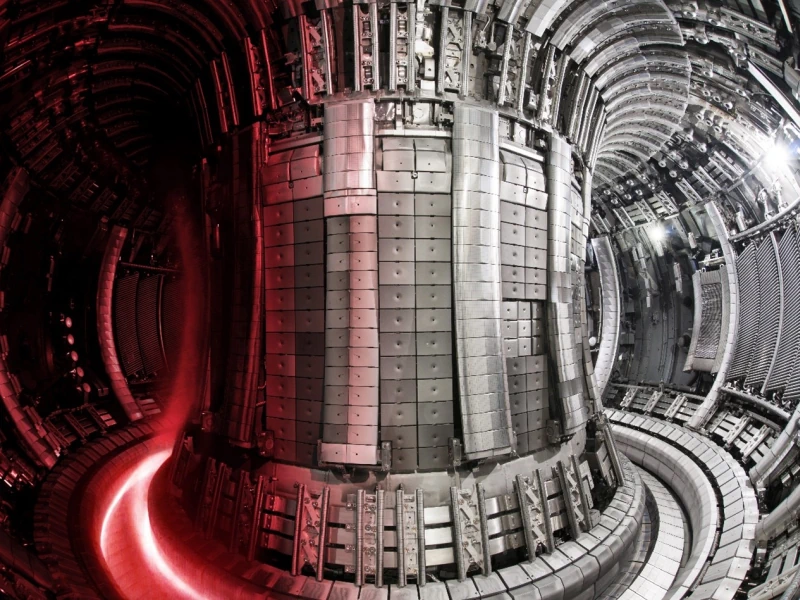
Most magnetic confinement systems therefore use a toroidal (doughnut-shaped) geometry. Within this geometry, twisted magnetic field lines form nested magnetic surfaces that guide particles along helical paths.
In magnetic confinement systems, plasma is produced from low-pressure gas and heated using multiple methods. Ohmic heating through plasma current provides initial temperature rise. Additional heating is supplied by high-energy neutral beam injection and radiofrequency electromagnetic waves.
Temperatures exceeding 100 million degrees Celsius are routinely achieved in today’s leading experiments.
Two major magnetic confinement concepts dominate: tokamaks and stellarators.
Tokamaks
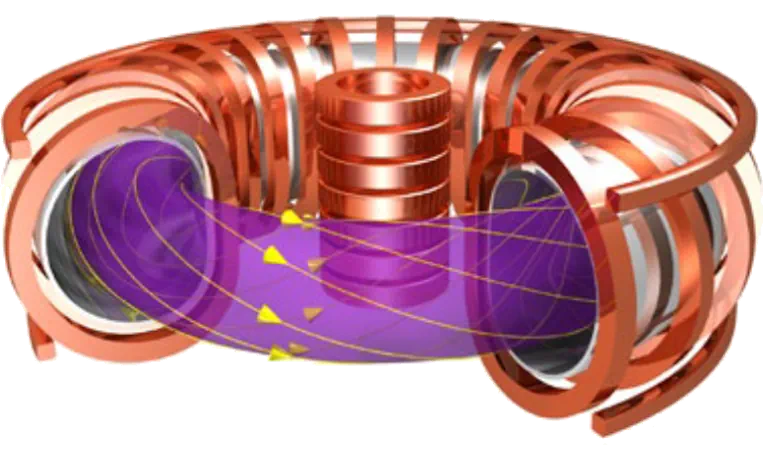
Tokamaks combine a strong external magnetic field with a current driven through the plasma. The plasma current generates an additional magnetic field, and together they produce helical field lines that improve confinement.
Germany has played a central role in tokamak development. The ASDEX Upgrade experiment in Garching, operated by the Max Planck Institute for Plasma Physics, remains one of the world’s leading tokamaks and has been crucial in developing high-performance operating regimes and plasma–wall interaction concepts.
Internationally, the largest tokamak under construction is ITER in southern France. ITER is designed to demonstrate a burning plasma with significant net Fusion gain and represents the most ambitious global Fusion collaboration to date.
Other major tokamaks worldwide include JET (UK), DIII-D (USA), EAST (China), and JT-60SA (Japan).
Stellarators
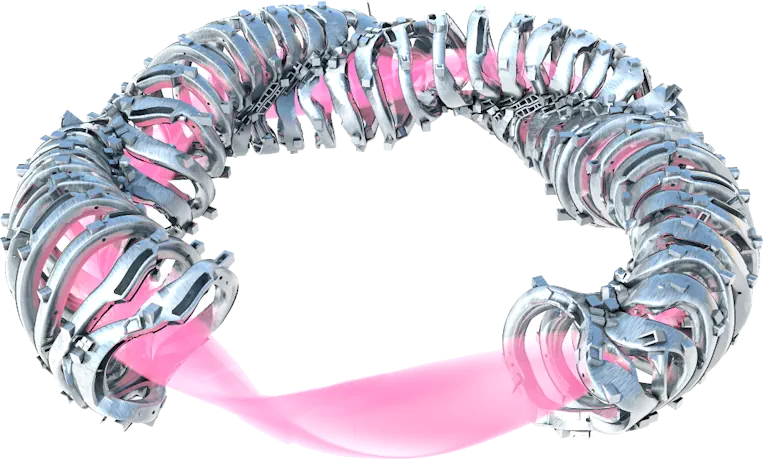
Stellarators achieve magnetic confinement entirely through external coils, without requiring a large plasma current. The necessary twist of magnetic field lines is built directly into the three-dimensional coil geometry. This enables steady-state operation in principle and reduces current-driven instabilities.
Germany is home to the world’s most advanced stellarator, Wendelstein 7-X (W7-X) in Greifswald, operated by the Max Planck Institute for Plasma Physics. W7-X is designed to demonstrate optimized steady-state stellarator operation and has set important benchmarks in plasma duration and confinement quality for this configuration.
Alongside public research, Germany also hosts a growing private stellarator ecosystem. Proxima Fusion is developing advanced stellarator power plant designs using computational optimization and modern magnet technology. Gauss Fusion is likewise pursuing a stellarator-based pathway, focusing on engineering integration and a power-plant-oriented development route in close connection with industrial capabilities.
Stellarators offer an attractive combination of steady-state capability and intrinsic stability, but require exceptionally sophisticated coil design and manufacturing precision.
Inertial Confinement Fusion (ICF)
Inertial confinement Fusion takes a fundamentally different approach. Instead of confining a low-density plasma for seconds, it compresses a tiny fuel capsule to extremely high density for a very short time — typically a few nanoseconds.
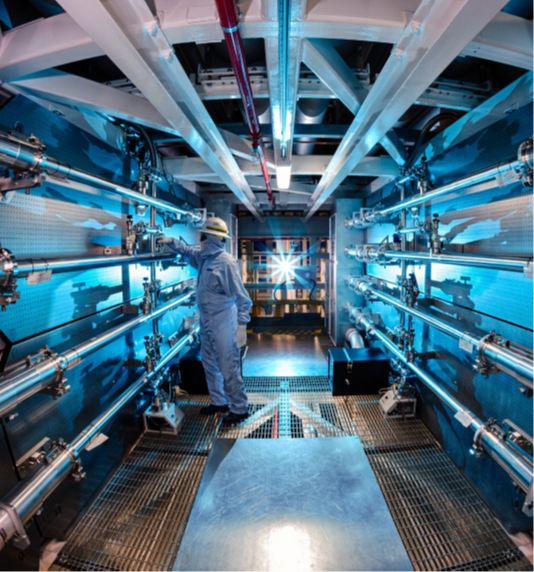
Powerful laser systems rapidly heat and compress a small spherical capsule containing deuterium–tritium fuel. The outer layer expands outward, driving the inner fuel inward in a symmetrical implosion. During this brief period of extreme density and temperature, Fusion reactions occur.
Direct vs. indirect drive ICF
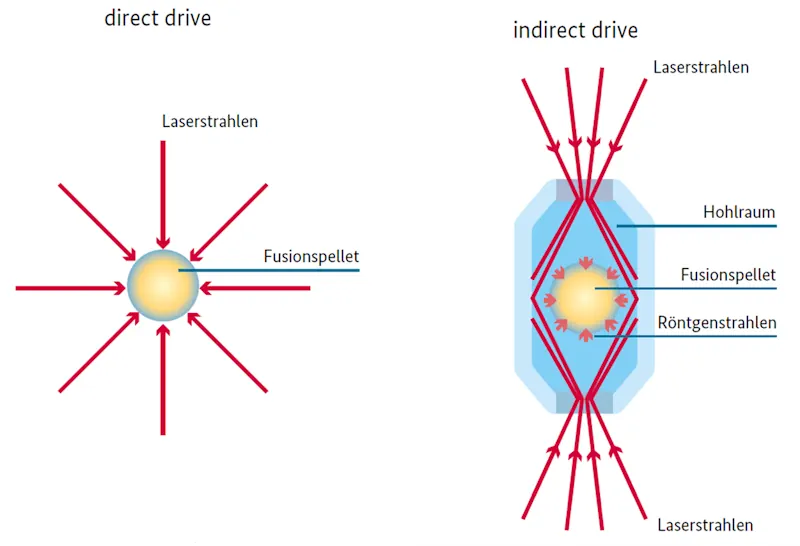
Two primary configurations exist:
- Direct drive, where lasers illuminate the capsule surface directly.
- Indirect drive, where lasers first generate X-rays inside a cavity to compress the capsule symmetrically.
A major milestone in this field was achieved at the National Ignition Facility (NIF) in the United States, where laser-driven Fusion ignition has been experimentally demonstrated.
Emerging Laser-Driven Approaches
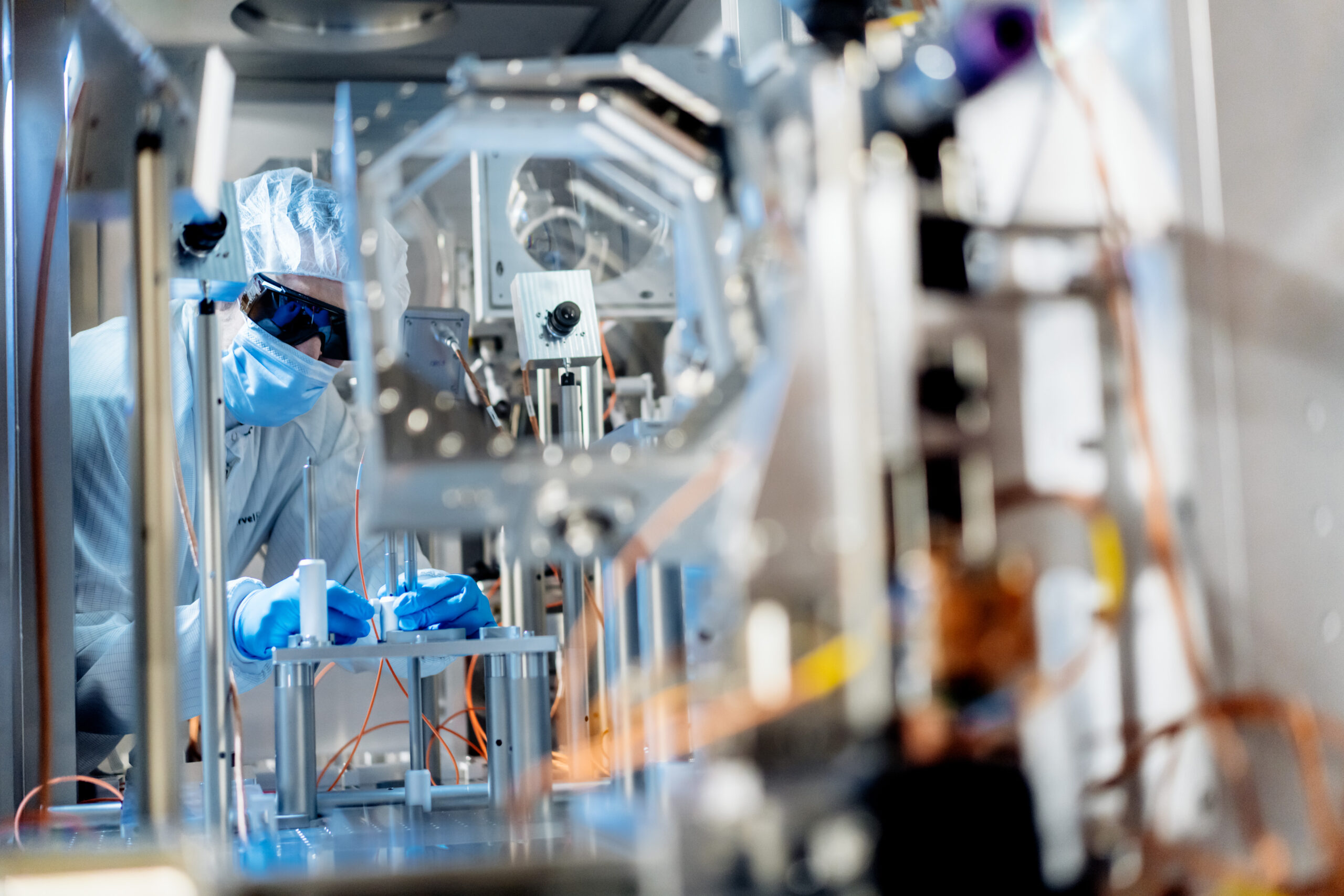
Recent years have seen strong private-sector engagement in inertial Fusion, including in Germany.
Marvel Fusion is developing a laser-driven approach based on ultra-short, high-intensity laser pulses interacting with structured fuel targets. The concept aims to exploit advanced laser–plasma physics and high-repetition-rate laser systems to enable more compact and economically scalable fusion systems.
Focused Energy is pursuing advanced inertial Fusion concepts that combine high-energy laser compression with optimized target designs to improve efficiency and repetition rate.
Other Fusion Concepts
Beyond tokamaks, stellarators, and laser-driven ICF, additional approaches are under investigation. Magnetic mirror machines confine plasma in linear systems using stronger magnetic fields at the ends to reflect particles back toward the center. Other concepts include field-reversed configurations, compact toroids, magnetized target Fusion, and pulsed magnetic compression systems.
A Diverse and Growing Fusion Landscape
Germany today hosts both world-leading public Fusion research facilities and a rapidly growing private Fusion ecosystem. From ASDEX Upgrade and Wendelstein 7-X to ITER participation and multiple venture-backed startups such as Proxima Fusion, Gauss Fusion, Focused Energy and Marvel Fusion, the country plays a central role in shaping the future of Fusion energy.