
Fusion in Germany
To enable the construction and operation of a commercial fusion power plant in Germany.
Strategic Objective: The World's First Commercial Fusion Power Plant
Germany has set itself an ambitious goal: to become the location of the world's first commercial fusion power plant.
This ambition is firmly anchored in the Federal Government's Hightech Agenda Deutschland (HTAD) and is actively supported by the Federal Ministry for Research, Technology and Space (BMFTR). Fusion is no longer viewed solely as a long-term scientific endeavor, but as a future energy technology and an opportunity for industrial leadership. The objective is not only to advance fusion research, but to create the scientific, technological, industrial, regulatory, and financial conditions required to bring fusion energy from the laboratory to the grid.
To achieve this objective, Germany is building a national fusion ecosystem that combines world-leading research institutions, innovative startups, industrial capabilities, investors, and public stakeholders. The country already hosts internationally recognized fusion research facilities, a rapidly growing private fusion sector, and a strong industrial base with expertise in superconducting magnets, advanced materials, cryogenics, lasers, optics, vacuum technology, precision manufacturing, and complex system integration.
A key element of the current strategy is the establishment of three national Fusion Hubs dedicated to:
- Magnetic Confinement Fusion (MCF)
- Inertial Confinement Fusion (ICF)
- Fusion Materials and Fuel Cycle Technologies
The hubs are intended to strengthen collaboration between research organizations, industry, and startups, accelerate technology transfer, and support the development of the supply chains required for future fusion power plants.
For industry, this ambition creates significant opportunities. The development, construction, and operation of fusion power plants will require a broad range of advanced technologies and specialized services. Companies that engage today can position themselves early within a future high-technology market that has the potential to become a major industrial sector in the coming decades.
Startup Momentum and Industrial Acceleration
Germany hosts a growing number of fusion startups developing commercial reactor concepts in both magnetic confinement and laser-based approaches.
These companies aim to:
- Accelerate the transition from experimental research to power plant design
- Develop reactor-relevant subsystems at industrial scale
- Shorten commercialization timelines
Their activities create early demand for:
- High-performance magnet systems
- Advanced materials
- Laser and optics technologies
- Precision manufacturing
- Power electronics and control systems
Startups therefore play a central role in shaping emerging supply chains and creating industrial momentum within Germany.
Industrial Opportunity: Building the Fusion Supply Chain
The ambition to deploy fusion power plants creates future demand across multiple technology domains:
- Superconducting magnets and cryogenics
- Vacuum systems and high-precision welding
- Neutron-resistant structural materials
- Tritium handling and fuel cycle systems
- Laser systems and advanced optics
- High-power RF systems and power electronics
- Robotics and remote maintenance
- Balance-of-plant engineering and grid integration
Germany already possesses strong capabilities in these sectors, including:
- Advanced mechanical engineering
- Specialty materials manufacturing
- Optics and photonics industries
- Nuclear-grade quality assurance
- Systems engineering and large-scale integration
Early engagement in fusion projects allows companies to:
- Enter qualification processes early
- Influence technical standards
- Establish long-term industrial partnerships
- Position themselves within future export markets
Fusion is a long-cycle market with high technological barriers — and correspondingly high value creation potential.
Industry Associations and Networks
Coordination, Representation and Market Development
The emerging fusion industry is supported by structured industry associations at both national and European level.
These networks provide:
- Policy representation
- Strategic coordination
- Visibility within the fusion ecosystem
- Access to European programs and partnerships
National Level: Pro-Fusion
In Germany, pro-fusion serves as the industry association representing companies active in fusion technology and related supply chains.
pro-fusion supports:
- Industry-policy dialogue
- Coordination of industrial interests
- Visibility of German suppliers
- Strategic positioning at national and European level
Website: https://www.pro-fusion.org
For companies entering the fusion market, Pro-Fusion provides a structured platform for networking and engagement.
European Level
German companies are also active within several European fusion industry networks, including:
- EFA – European Fusion Association
- Fusion Europe
- Fusion Now
- FIA Europe – Fusion Industry Association Europe
These organizations contribute to:
- European policy coordination
- Alignment with EU funding instruments
- Cross-border industrial matchmaking
- Market development strategies
Active participation strengthens access to European demonstration projects and future commercial programs.

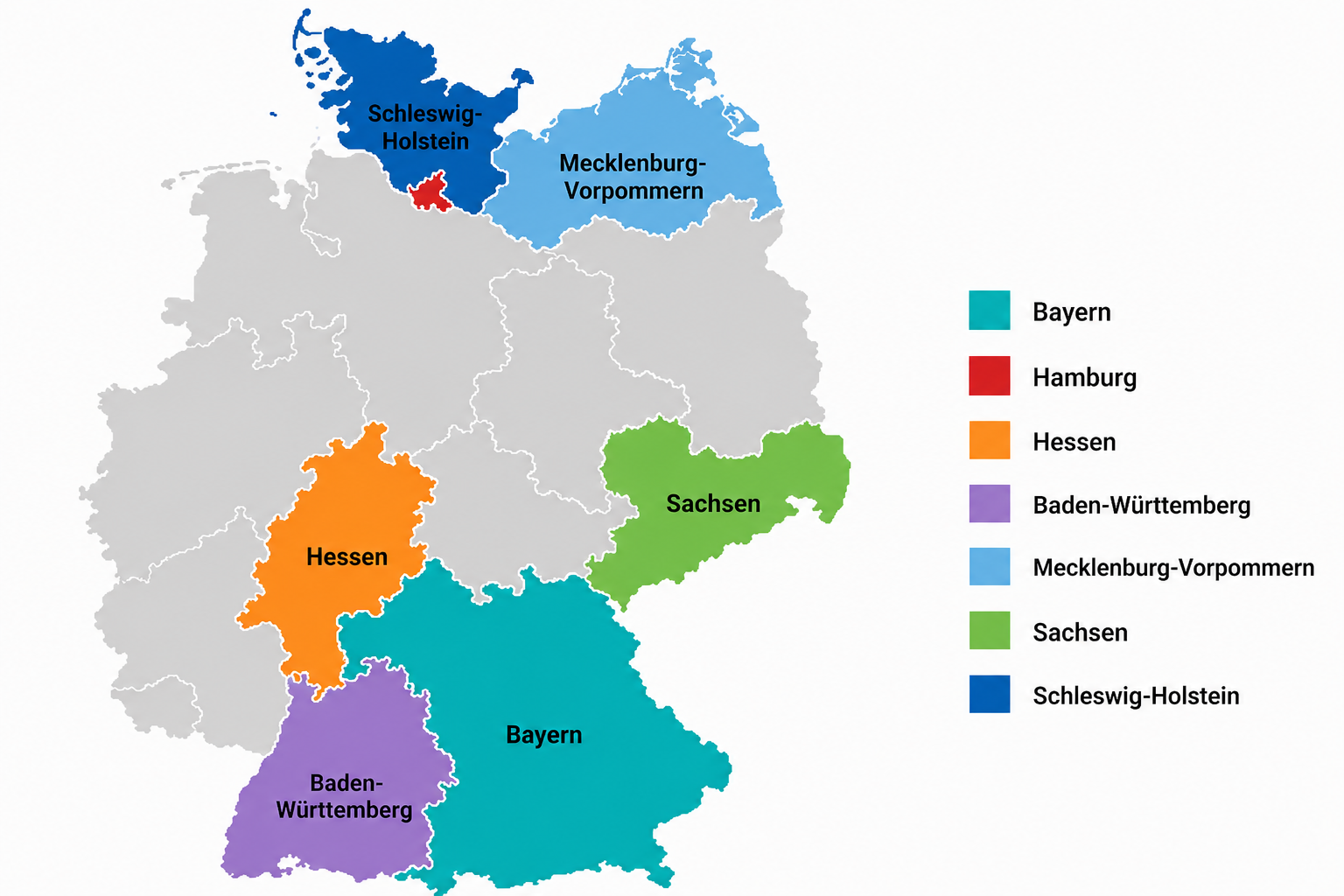
Fusion-Allianz der Bundesländer
Regional Commitment to Deployment
Several German states have established the Fusion-Allianz der Bundesländer, signaling long-term regional commitment to fusion technology.
The alliance reflects:
- Strategic interest in hosting future demonstration or commercial facilities
- Alignment of regional industrial clusters with fusion technology needs
- Integration of fusion into structural and economic development strategies
For the supply chain, this provides additional political stability and long-term visibility.
From International Participation to Domestic Deployment
German industry is already deeply involved in European and international fusion projects, including ITER and related supply chains.
Experience gained in:
- Large-scale superconducting systems
- Nuclear-grade component manufacturing
- Precision assembly and integration
- Complex quality assurance processes
forms a technological and organizational foundation for future:
- European demonstration plants
- National pilot facilities
- Commercial first-of-a-kind fusion power stations
Fusion as Industrial and Energy Strategy
Germany’s fusion strategy combines:
- Energy security considerations
- Climate neutrality objectives
- Industrial competitiveness
- Technology sovereignty
- Regional structural development
The strategic objective — a commercial fusion power plant in Germany — provides the organizing framework.
For the supply chain, the decisive question is positioning:
How early and how effectively companies integrate into the emerging fusion ecosystem will shape their role in one of the most technologically demanding industrial markets of the coming decades.