
ITER is the world’s largest fusion experiment and the central international step toward demonstrating burning plasma operation at reactor scale.
The project is under construction in Cadarache, southern France, and aims to demonstrate a fusion gain of Q ≥ 10, meaning ten times more fusion power than external heating power.
ITER is not a power plant. It is a research facility designed to validate the physics and technologies required for future fusion power stations.
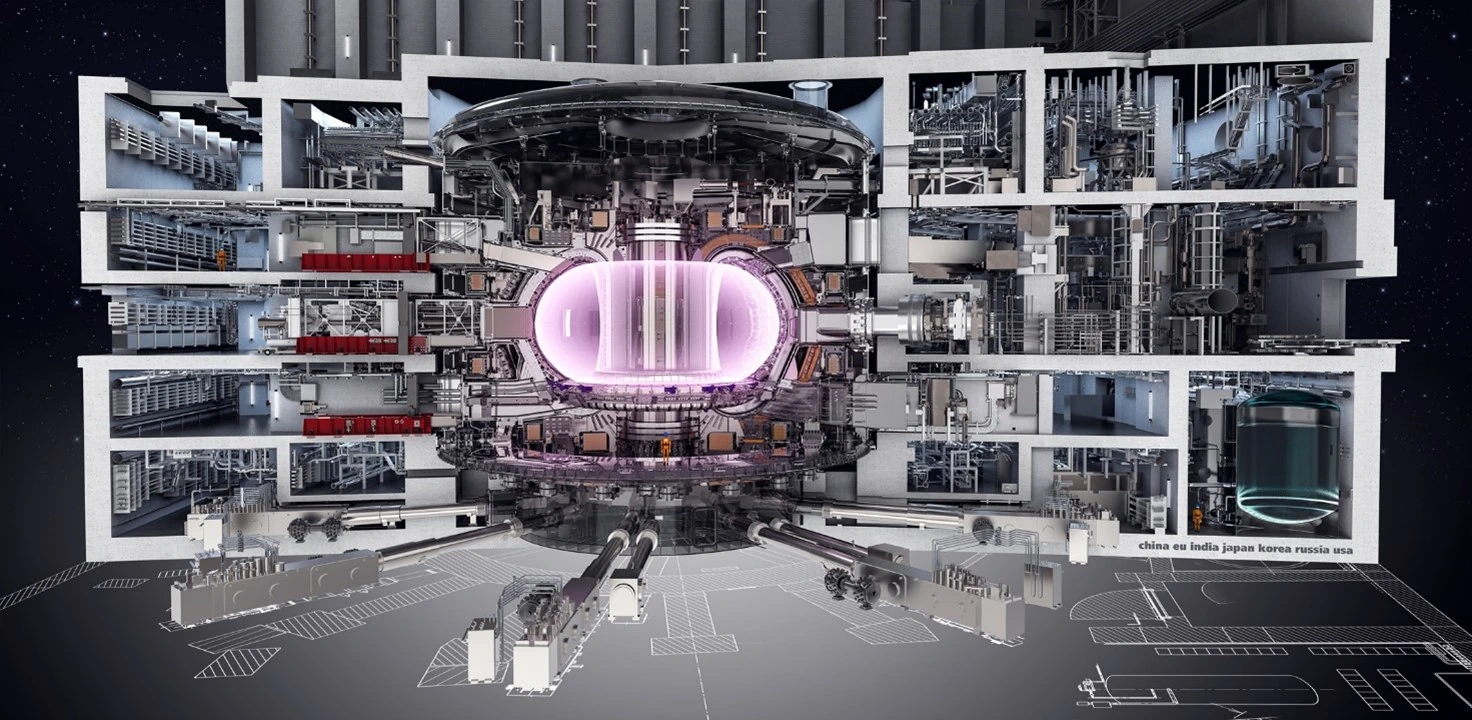
International Partnership
ITER is a global collaboration between seven members:
- European Union (host and largest contributor)
- China
- India
- Japan
- Korea
- Russia
- United States
Together, these partners represent more than half of the world’s population and around 85% of global GDP.
Europe, as host, contributes approximately 45% of the construction cost. The other six members each contribute roughly 9%.
Contributions are largely provided “in-kind,” meaning that each member is responsible for designing, manufacturing, and delivering specific components rather than transferring cash.
Domestic Agencies and the Role of Europe
Each ITER member delivers its components through a dedicated Domestic Agency (DA).
For Europe, the responsible Domestic Agency is:
Fusion for Energy (F4E)
The European Joint Undertaking for ITER and the Development of Fusion Energy.
F4E manages European industry contracts, technical oversight, and component delivery to ITER. It is the primary procurement interface for European companies wishing to participate in ITER construction.
F4E website (procurement and calls):
https://fusionforenergy.europa.eu
ITER Organization website:
https://www.iter.org
European companies do not contract directly with the ITER Organization for most hardware — they contract via F4E.
Project Roadmap and New Baseline
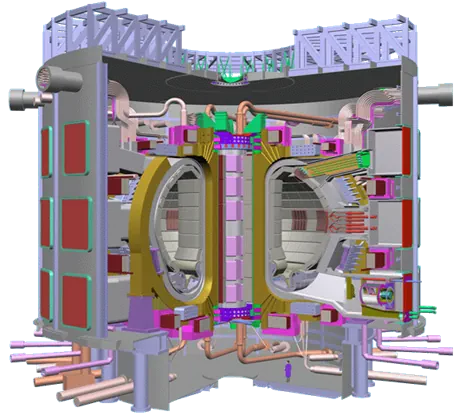
ITER construction has progressed through major civil engineering, component manufacturing, and assembly phases.
Following technical reviews and schedule reassessment, ITER adopted an updated project baseline. The revised roadmap prioritizes a staged approach:
- Completion of Tokamak assembly
- First Plasma (revised schedule)
- Progressive installation of additional systems
- Transition to deuterium–tritium operation
Key upcoming milestones include:
- Completion of major sector module installation
- Vacuum vessel closure
- Integrated commissioning
- First Plasma
- Installation of tritium systems
- Start of D–T experimental campaigns
The D–T phase will mark the start of full fusion power operation at scale.
What ITER Means for Industry
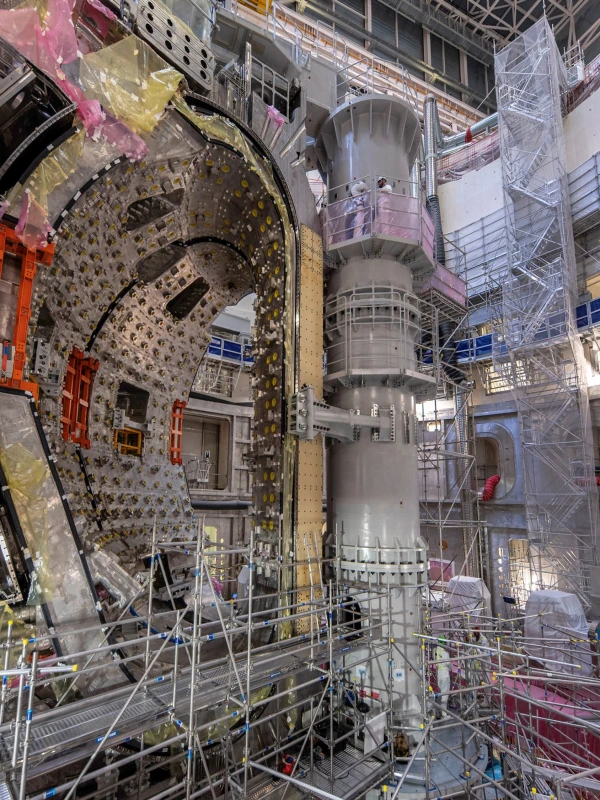
ITER is one of the most complex scientific and industrial projects ever undertaken. It involves:
- Superconducting magnets
- Cryogenic systems
- High-vacuum systems
- Remote handling robotics
- High-power RF systems
- Precision manufacturing
- Nuclear-grade quality assurance
European industry plays a leading role in delivering:
- Toroidal field coils
- Vacuum vessel sectors
- Cryostat components
- In-vessel systems
- Diagnostics
- Power supplies
ITER procurement is governed by nuclear-grade quality standards, traceability requirements, and long-term contractual frameworks.
For companies in the fusion supply chain, ITER represents:
- A reference project at global scale
- Entry into nuclear-grade manufacturing
- Long-term technology positioning for future fusion power plants
How to Participate (Supply Chain Entry Points)
Companies interested in ITER-related contracts should monitor:
Fusion for Energy (F4E) procurement portal
Calls for tender, framework contracts, qualification procedures
https://fusionforenergy.europa.eu
ITER Organization procurement portal
Direct international tenders and global supplier registration
https://www.iter.org/proc/overview
In addition, national fusion networks and industry associations often coordinate consortia and supply-chain engagement for ITER contracts.
Strategic Perspective
ITER is the bridge between experimental fusion research and industrial-scale fusion power plant development (DEMO). Participation in ITER supply chains today positions companies for the next generation of fusion facilities.
Germany, as a leading European industrial nation and major contributor to ITER via F4E, plays a central role in high-technology manufacturing for the project.